
Here’s what started this whole thing. I was reading through a stack of peptide forum posts, the kind with screenshotted “protocols” that get reposted so many times nobody remembers where they came from, and every single one gave AOD-9604 dosing in the same confident shorthand: a specific microgram number, a specific injection site, morning cardio on an empty stomach for best results. It read like a doctor’s note. So I did what I always do when something sounds too tidy: I went looking for the study it was supposedly built on.
I did not find one. What I found instead was a real, published, and fairly modest research record that looks almost nothing like the charts people are following.
I want to be upfront about where this landed before I walk through how I got there. AOD-9604 is not an FDA-approved drug. Nothing in the published human research shows any dose of it producing meaningful weight loss. That’s not my opinion, it’s the conclusion the primary sources themselves point to, and I checked.
The question I had
Simple enough: is there an actual clinical basis for the injectable microgram amounts circulating online, or are people just repeating each other?
What I dug up first: the trials that exist used a completely different route than the protocols do
The thing nobody puts in the pull-quote is that the real human studies of AOD-9604 didn’t inject it. They gave it orally.
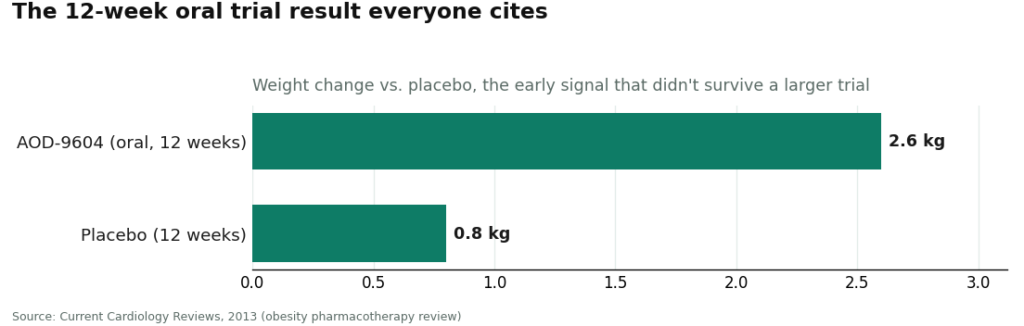
The safety data comes from a 2013 paper in the Journal of Endocrinology and Metabolism, which pooled roughly 900 adults across six randomized, placebo-controlled studies of an orally dosed formulation. It reported a safety and tolerability profile “indistinguishable from placebo,” with no drug-related serious adverse events [P5]. The one efficacy number that keeps getting cited by people defending the compound, an early 12-week result showing about 2.6 kg of weight loss versus 0.8 kg on placebo, comes from a review of that same oral-dosing program, published in Current Cardiology Reviews in 2013 [P4].
I read that twice to make sure I wasn’t missing something. I wasn’t. Every popular protocol I found online said “inject subcutaneously.” The trials that generated the actual human numbers gave it by mouth. That’s not a small technical footnote, it’s the whole foundation of the dosing conversation, and it means an injectable microgram figure was never validated by any human efficacy trial, because no human efficacy trial injected it.
What I dug up second: even the right route didn’t hold up under a bigger test
Okay, I thought, so maybe the oral dose at least worked, and someone just repurposed the number for injections. Fair question. The answer, once I found the rest of the record, was no.
That 2.6 kg vs 0.8 kg result was from an early, smaller trial. It’s the number that built the compound’s reputation, and taken alone it looks encouraging. But an early signal is a hypothesis, not a finding, and somebody actually ran the bigger, longer trial to test it. According to the same independent review, AOD-9604’s development “was terminated in 2007 as the drug failed to induce significant weight loss in a 24-week trial of 536 subjects” [P4]. That’s the properly powered study, on the same oral route that produced the encouraging early number, and it didn’t confirm it.
Sitting with that, I realized what it actually means for dosing: there is no validated effective human dose of AOD-9604 for weight loss, full stop, because the trial designed to prove the effect at its tested amount didn’t prove it. A chart that hands you a precise number is implying that number does something. The record doesn’t support that implication for any amount, injected or oral.
What I dug up third: the one place with real numbers is the one place they can’t be borrowed from
I’ll admit the animal data initially threw me, because it’s the most specific and confident-sounding part of the whole literature. A 2000 study in Hormone Research gave obese Zucker rats a daily oral dose of 500 micrograms per kilogram of body weight for 19 days, and it cut body weight gain by more than 50% without hurting insulin sensitivity [P1]. That’s a real, dosed, positive result. I can see exactly how someone squints at that number and tries to back into a human injection amount.
But it doesn’t convert. It’s a per-kilogram oral dose, in a rat bred for obesity, over 19 days, measuring weight gain reduction, not weight loss in an adult human. Translating an animal dose into a fixed human injection isn’t arithmetic, it’s a formal pharmacology exercise, and the actual attempt to find a working human dose already happened, in the human trials, and it failed. The rat number is genuine. It just isn’t a shortcut to a human protocol, and the failed 536-person trial is the direct evidence that the shortcut doesn’t work.
What surprised me
Honestly, it was how confidently the injectable protocols are written given how thin the trail underneath them is. Once I traced it back, the online dosing figures seem to be a blend of the rat lipolysis data, a general “AOD-9604 breaks down fat” rationale, comparisons to other growth-hormone-fragment routines, and a lot of repeated anecdote. None of that is a controlled human dose-finding trial for an injected version, because no such trial exists. What surprised me wasn’t that the number was uncertain. It’s that it’s dressed up to look exactly like a clinical figure when it’s really more like a crowd-sourced guess that calcified into a chart.
What I’d do
If dosing here is this unsettled, precision isn’t the thing to chase, oversight is. That’s the part a forum thread or a vial from an unregulated seller simply can’t provide: someone who reviews your actual history, sets expectations against the real evidence rather than a screenshot, and stays reachable if something feels off.
That’s the model FormBlends operates on: a physician evaluates the individual, a prescription gets written where appropriate, and a licensed pharmacy compounds and dispenses the peptide. Naming that here isn’t an endorsement or a nudge to buy anything, there’s nothing for sale in this piece. It’s just a description of what supervised access looks like, for the same reason the source evidence points to needing it: nobody, including a chart, can conjure a validated dose the research never produced.
The other piece I’d actually do myself is keep a record. With something this unproven, a log of exact doses and any symptoms, over time, is more useful walking into a clinical conversation than a confident-sounding protocol you found online. A tool like the FormBlends tracker app just holds that log; it doesn’t prescribe anything or process a purchase. But the underlying habit matters regardless of the app: document what you actually took and what actually happened, because that’s real data about you, and a forum chart is not.
Where I landed
Assembled from the sources themselves, here’s the honest shape of it. The human trials used oral dosing, not the injections that dominate online protocols [P4][P5]. On that studied route, the pivotal 24-week, 536-person trial failed to beat placebo, so no effective human dose was ever confirmed [P4]. The animal studies had real, specific, effective doses, but they’re rodent, oral, per-kilogram figures that don’t translate into a human injection amount, and the failed human trials are the proof that translation didn’t hold [P1]. The injectable microgram protocols circulating now are, as far as I can trace them, community-built rather than trial-derived.
So no, I didn’t come away with a number. I came away with a caution: treat any precise AOD-9604 dosing chart as offering more certainty than the underlying research actually contains. For a compound whose biggest trial missed its own target, skepticism toward precision is the more evidence-aligned stance than following it.
Questions I kept coming back to
Is there an actual validated dose of AOD-9604 for weight loss?
No, and I looked hard for one. The trial built to prove an effect at its tested dose, 24 weeks, 536 people, failed to beat placebo on weight loss [P4]. Since the pivotal study didn’t show the compound working at the amount it tested, nothing in the literature establishes an effective human dose. Any chart claiming otherwise is more confident than the data allows.
If the studies used oral dosing, why does every online protocol say to inject it?
Because those protocols aren’t drawn from the human trials, which were oral [P4][P5]. They’re stitched together from the rat lipolysis findings, the general fat-breakdown rationale, comparisons to other growth-hormone-fragment routines, and a lot of repeated user experience. No human efficacy trial ever tested an injected dose, so the injectable amounts circulating now were never the amounts actually studied in people.
Can I just convert the rat dose, 500 micrograms per kilogram, into a human injection?
I wanted to, honestly, but no. That figure is an oral dose given to bred-obese Zucker rats over 19 days, and it measured reduced weight gain in rodents, not weight loss in adult humans [P1]. Converting an animal dose to a human one isn’t simple per-kilogram math, it’s a formal pharmacology process, and the failed human trials are direct evidence the translation didn’t carry over.
What did that early 12-week study actually show, the one everyone cites?
A modest result: about 2.6 kg of weight loss versus 0.8 kg on placebo, over 12 weeks of oral dosing [P4]. That’s the number that built AOD-9604’s reputation. But it was an early signal, not a confirmed effect, and when researchers ran the larger, longer, properly powered trial to test it, the effect didn’t hold up.
Is AOD-9604 approved as a weight-loss drug anywhere?
No. It’s not FDA-approved for weight loss, and its clinical development was shut down in 2007 after the 24-week trial failed [P4]. I also found it described elsewhere in the literature as having a food-ingredient classification, which is a completely different thing from evidence that any dose produces meaningful human weight loss.
After all this reading, what’s the most honest way to think about dosing?
Be suspicious of precision, not reassured by it. For a compound whose largest trial failed at its own tested dose, no specific figure can honestly be called effective. A documented personal log of what was taken and what happened afterward tells you more than any protocol screenshot ever will. The takeaway I’d stand behind isn’t a number, it’s a warning label.
References
- Obese Zucker rats given oral AOD9604 at 500 micrograms/kg/day for 19 days reduced body weight gain by over 50% without harming insulin sensitivity (animal study). Metabolic studies of a synthetic lipolytic domain (AOD9604) of human growth hormone. Hormone Research, 2000. https://pubmed.ncbi.nlm.nih.gov/11146367/
- Independent obesity-pharmacology review: AOD-9604 12-week oral trial showed ~2.6 kg vs 0.8 kg placebo, but development was terminated in 2007 after the drug failed to induce significant weight loss in a 24-week trial of 536 subjects. Obesity Pharmacotherapy: Current Perspectives and Future Directions, Current Cardiology Reviews, 2013. https://pmc.ncbi.nlm.nih.gov/articles/PMC3584306/
- Human safety pooled across ~900 adults in six randomized, placebo-controlled studies of an orally administered compound: tolerability “indistinguishable from placebo,” no drug-related serious adverse events. Safety and Tolerability of the Hexadecapeptide AOD9604 in Humans, Journal of Endocrinology and Metabolism, 2013.
- AOD9604 described as a nutraceutical ingredient with GRAS status for foods, drinks and dietary supplements (a food-ingredient classification, not a drug approval or dosing guidance). Safety and Metabolism of AOD9604, Journal of Endocrinology and Metabolism, 2014.
AOD-9604 is not an FDA-approved drug, and no dose has been shown to produce meaningful weight loss in humans.
What side effects turned up in the actual trials?
The trials that finished reported no serious adverse events at the oral doses tested, which is reassuring as far as it goes, but it doesn’t cover everything I’d want to know. Those studies used specific formulations, controlled settings, and screened participants. The injectable protocols floating around online haven’t gone through anything like that scrutiny, so injection-site reactions, unknown systemic effects, and contamination risk from unregulated sources are real concerns the published data simply can’t rule out.
Based on what I read, does AOD-9604 actually work for fat loss in people?
My honest read is that the evidence is thin and inconsistent. There was an early signal at certain oral doses, but the larger, later trials didn’t consistently reproduce meaningful fat loss over placebo, and no phase III trial ever finished. The animal data looks more convincing, but animal-to-human translation in metabolic research has a poor track record, and this compound is a case in point. Calling it a proven fat-loss tool overstates what I found in the record.
Is it even legal to buy?
It depends a lot on where you are and who’s selling it. In the US, AOD-9604 isn’t FDA-approved for anything, so retail sale as a “research chemical” or supplement sits in a regulatory grey zone that can shift under it. Compounding pharmacies working under physician supervision, like FormBlends, operate inside a defined legal and accountability structure. Buying loose peptide vials from unregulated online sellers is a murkier picture, and not one I’d want to navigate without knowing that going in.
How does AOD-9604 actually differ from HGH or HGH fragment 176-191?
AOD-9604 is a synthetic peptide built from the tail end of human growth hormone, the piece thought to influence fat metabolism without triggering the growth-promoting or insulin-resistance effects tied to full HGH. HGH fragment 176-191 refers to that same region, and the two terms get used almost interchangeably in online communities, which adds to the confusion rather than clearing it up. Neither one is full HGH, and neither one carries HGH’s approval status or its decades of accumulated clinical data.
Written by Hassan Bianchi, health correspondent. Reporting from the sources cited above. Last reviewed May 2026.
General educational purposes only. Your physician should be part of any treatment decision.
