
Real Takeaways for Beating College Burnout
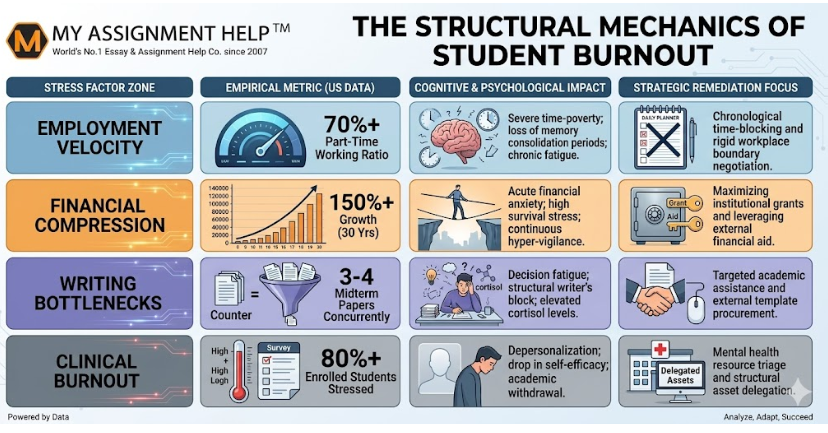
- The Reality of Time-Poverty: Over 70% of US undergrads work while enrolled, creating massive mental exhaustion.
- Smart Task Delegation: Delegating routine, non-essential assignments reduces daily stress and protects your GPA.
- Setting Work Boundaries: Keeping a strict separation between work shifts and study time protects your focus.
- Using Available Resources: Don’t struggle in silence; use student support systems and external tools to manage the load.
Introduction: The Dual Identity Crisis in US Higher Education
The everyday reality of American higher education has undergone a massive shift. The old-school image of the full-time college student—someone who spends their days purely on classes, campus clubs, and studying in the library—doesn’t match what is actually happening on the ground anymore. Today, the “student-worker” is the true face of United States colleges and universities. Driven by skyrocketing tuition costs, flat wages, and an incredibly competitive job market, millions of undergrads are forced to balance heavy part-time or full-time jobs alongside demanding class schedules.
This lifestyle split has created a mental health crisis that most university frameworks just aren’t built to handle: academic burnout. Far from being standard exam-week stress or a temporary lack of motivation, burnout among modern student-workers is a deep, chronic state of mental exhaustion. It shows up as a mix of total emotional drainage, a cynical detachment from classes, and a feeling that you are constantly falling behind. This silent epidemic hurts student mental health, lowers focus, and causes dropouts across American colleges. Dealing with it requires looking past basic self-care tips like “drink more water” and addressing the real schedule pressures students face daily.
The daily pressure can get overwhelming when you are trying to handle advanced general education requirements alongside tough major classes. To avoid total exhaustion and keep their career goals on track, many undergrads choose to buy coursework online to help balance their weekly schedules. Partnering with an established professional support resource allows busy working students to protect their baseline Grade Point Average (GPA) without having to quit their jobs or sacrifice their physical well-being. By recognizing when the sheer volume of assignments exceeds what is humanly possible in a 24-hour day, smart students treat college like a project management task where using outside resources is just a smart business decision.
The Macroeconomic Drivers of Student Labor in the United States
To truly understand why this burnout epidemic is happening, you have to look at the economic pressures shaping the lives of American college students. Data from the National Center for Education Statistics (NCES) shows that roughly 40% of full-time undergrads and over 70% of part-time students are working while earning their degrees. This work isn’t for extra spending money; it is a basic survival necessity. The cost of attending a four-year public or private university in the US has jumped by more than 150% over the last thirty years, completely outrunning federal financial aid expansions and average family income growth.
Because of this, students are caught in a major financial squeeze. They have to work long hours at internships, retail jobs, or gig-economy gigs just to pay for rent, groceries, expensive textbooks, and health insurance. This reality causes severe “time-poverty.” When you are clocking 20 to 30 hours a week at a workplace, you lose the vital downtime your brain needs to rest, process new information, and recover mentally. Constantly jumping back and forth between professional job demands and complex college assignments drains your mental battery, leaving you permanently exhausted.
This severe lack of time becomes incredibly dangerous during major assignment pile-ups, like midterm exams and final research papers. When all these big assignments hit at the exact same time, students frequently decide to buy college essay papers so they can access high-quality structural blueprints and well-researched academic templates. Using specialized writing platforms gives students solid reference materials that speed up their drafting and research process. This targeted writing assistance acts as an essential safety valve, allowing student-workers to meet intense university guidelines without hitting a breaking point.
The Psychology of Burnout: Recognizing the Neurobiological Toll
From a psychological perspective, academic burnout is far more than a bad attitude. When you are under constant, unmanaged stress—like working a 25-hour week while carrying 15 credits of pre-med or engineering courses—your brain stays in a perpetual “fight or flight” mode. The continuous stress response leads to a constant flood of cortisol and adrenaline. Over time, this chemical overload impacts the prefrontal cortex, which is the exact area of the brain responsible for critical thinking, memory, emotional control, and decision-making.
As your brain gets drained, student-workers begin to experience the three classic signs of clinical burnout:
1. Total Emotional Drainage
You feel completely empty of physical and mental energy. Waking up to face a long day of back-to-back retail shifts and late-night study sessions feels impossible. Chronic physical exhaustion is often paired with insomnia, getting sick more often, and constant tension headaches.
2. Detachment and Cynicism
The excitement you originally had for your major or future career turns into bitterness. You start viewing assignments as pointless busywork. You isolate yourself from classmates, stop participating in campus life, and detach emotionally just to protect yourself from further stress.
3. A Feeling of Constantly Failing
Even though you are working twice as hard as students who don’t have jobs, you feel like you aren’t doing anything well. You look at your grades or your work performance and feel like a failure in both worlds. This lack of confidence creates a frustrating cycle, making it even harder to tackle tough assignments.
Strategic Mitigation Frameworks for the Modern Student-Worker
Overcoming this challenge means looking past superficial advice like “get more sleep.” When you are genuinely out of time, generic wellness tips feel useless. Working students need practical, real-world strategies designed to optimize their limited hours and protect their mental health.
Using Strict Time-Blocking and Setting Job Boundaries
To stop feeling so scattered, you need to ditch chaotic multi-tasking and use strict time-blocking. This means setting aside unchangeable blocks of time dedicated strictly to studying, working your job, or resting. For example, you should give your boss a predictable availability schedule weeks in advance so surprise shifts don’t ruin your study routines. Similarly, when you are in your study block, turn off all work-related notifications completely to keep your focus sharp and avoid shifting stress.
Strategic Assignment Delegation and Resource Management
Successful professionals know that delegation is the ultimate tool for managing a packed schedule. Corporate executives don’t try to handle every single task themselves; they focus on major business goals and pass routine work to specialized teams. You should use this exact same mindset in college. When multiple big deadlines hit at once, prioritize the core classes for your major, and consider using professional academic platforms for general education requirements or standard writing assignments.
Making Use of On-Campus Support Systems
While many colleges don’t fix the high tuition costs that force students to work, they do offer campus resources to help manage stress. You should actively reach out to your university’s counseling center, academic advisors, and student support groups. Getting formal accommodations, like a short deadline extension or flexible testing times during your busiest work weeks, can give you the breathing room you need to prevent a busy week from turning into a total mental breakdown.
Conclusion: Shifting from Endless Endurance to Strategic Management
The widespread problem of academic burnout among working American students is proof that higher education needs to adapt to modern financial realities. As long as tuition fees stay high, undergrads will continue to bear the heavy double load of school and work. Fixing this problem requires changing how you view your education. You have to stop treating college like an endurance test to be survived, and start treating it like a project to be strategically managed.
See Also: How Technology Is Improving E-Commerce Platforms
By protecting your mental energy, setting firm boundaries with your employer, and using professional writing support when you are stuck, you can handle the intense pressure of college life. Ultimately, the goal isn’t just to scrape by and graduate—it is to enter the job market with a strong GPA, great work experience, and a healthy mind ready for long-term career success.
Strategic Operational Note: This analysis focuses entirely on US higher education dynamics and student-driven coping strategies. It operates independently of foreign regional regulatory frameworks, focusing strictly on localized American institutional standards and strategic workflow optimization.
Frequently Asked Questions Regarding Student-Worker Burnout
Q1: How to know if you have academic burnout or just normal tiredness?
A1: Normal tiredness goes away after a good night’s sleep or taking a weekend off. Academic burnout is a long-term state where you feel completely drained emotionally, feel bitter or detached from your classes, and notice a constant drop in your performance that a short break won’t fix.
Q2: Does using an online coursework platform hurt your long-term learning?
A2: If you use it strategically, it actually helps your education. Utilizing professional writing services to get high-quality structural outlines for general education classes or elective courses allows you to save your limited study time for mastering the core subjects required for your major.
Q3: How many hours can a student work before GPA drops?
A3: Educational research shows that working up to 12 or 15 hours a week can actually improve your time-management habits. However, once you start working more than 20 hours a week, severe time-poverty sets in, which usually causes a clear drop in college grades.
Q4: How to handle work during final exams college?
A4: Set clear boundaries early by giving your boss a printout of your exam schedule at the start of the semester. If your job still demands long hours during finals, request a temporary shift reduction or use external academic support services to handle routine assignment deadlines during that high-pressure week.
Empirical References & Data Sources
- National Center for Education Statistics (NCES). (2024). The Condition of Education: College Student Employment Metrics across US Higher Education. U.S. Department of Education.
- Maslach, C., & Jackson, S. E. (1981). The measurement of experienced burnout. Journal of Organizational Behavior, 2(2), 99-113.
- Georgetown University Center on Education and the Workforce. (2023). Learning While Earning: The Macroeconomic Reality of the Modern Student-Worker. Georgetown University.
- American Psychological Association (APA). (2025). Stress in America Report: Chronic Cognitive Fatigue and the Higher Education Landscape. APA Mind/Body Research Directorate.
About the Author
Dr. Marcus Vance, Senior Academic Content Strategist
Dr. Marcus Vance holds a Ph.D. in Higher Education Policy from the University of Michigan and brings over twelve years of pedagogical and institutional research experience to his role as a Senior Academic Content Strategist at MyAssignmentHelp. His research focuses on the intersection of student financial policy, neuro-cognitive load management, and the empirical design of scalable educational support systems. Dr. Vance regularly designs specialized academic frameworks that help modern student-workers maximize their educational ROI while protecting mental well-being and long-term career potential.
